Sunday, November 8, 2015

Insurance Claims & Storm Chasers

In mid 2015 a hail storm hit our town and the wind and hail caused damage to houses and vehicles. Some people only had minor damage, with just a few dings here and there... but others had major damage with broken windows on houses and vehicles and thousands of dollars worth of damage

We had damage to 3 sides of our house and our roof so we needed new siding and a new roof (among some other minor items). I'd never had experience with home insurance before and so we had no idea of the process involved in making a claim. Hopefully this post will help others when and if the time comes (and I hope, after all this stress, that we never have to deal with this again).
  1. Check 
  2. Report
  3. Inspection/Loss Report
  4. Quotes
  5. Repair
  6. Finalize
1. First, check your home and make sure there isn't any damage that allows the elements to enter your home. In our case we had a hole in one of our roof vents that was allowing rain to enter the roof. Fix any such issues and make sure you mention them specifically to insurance as in some cases they may deem your case more emergent.

2. Once you've determined the damage, call your insurance company and report it. If you have a mortgage, call your mortgage company as well and ask what the process is. Any insurance payments will be made payable to the insured and your mortgage company. Depending on your Lender (Bank) they might not need to do anything yet, or they might need to open a claim.

3. Your insurance company will send out an Inspector to assess the damage and they will generate a "Loss Report". This report shows where they think the damage is and how much you're entitled to in terms of Actual Cash Value (ACV) and Replacement Cost Value (RCV). They will usually send the ACV amount (typically much smaller than RCV) pretty close to the Loss Report being sent or at the same time.

4. I cannot stress enough that you should get multiple quotes, especially if you're getting a lot of work done, before settling on any one company or signing any contracts. Your insurance company/lender typically don't care what company you use so pick someone you're happy with and the cheapest isn't necessarily the best! Check their credentials, look them up online and make sure they're insured.

5. Once you've selected someone, get repairs started. My suggestion is to keep an eye on the work they're doing, take photos before, during and after the process. This probably isn't necessary but you'll be happy you did :) IF something comes up during the repair process that wasn't mentioned in the Loss Report your insurance provided, get a quote for that to be repaired and contact your insurance company to ask them to include this amount in your claims (as a supplement).

6. Once the work is complete, submit the invoice to insurance so that they can release your final check/cheque and finalize the claim. Pay your contractor and go on your merry way!

Unfortunately, because most everyone in our town was affected by this storm, I also had my first experience with storm chasers (unsavory companies that will sometimes come from states away to try and take advantage of the situation).

We had so many people and their vans emblazoned with their logos driving around town. They promise to help get your home fixed quickly, and make sure insurance paid for all of it (and then some) because they know how. They offered discounts for putting signs in your yard, discounts for referring other people and also offered to negotiate with insurance directly and work only for your insurance settlement, some in violation of Iowa Code 103A.71 (not that they seemed to care).

The standard scam is that they will offer to do the repairs for the insurance payout. While this in itself isn't necessarily a scam on you, they will often try and inflate claim amounts by charging for things they didn't do, charging a higher price than normal, or claiming more material was needed than actually was... all with the aim of getting your insurance company to pay more than they initially quoted in their Loss Report. They "chase storms" because the large volume of claims that a storm like this generates has the chance that the insurance companies aren't paying as close attention as they normally would and they instead just want to get claims processed and finalized and thus the contractors make a pretty penny!

Unfortunately for us we didn't totally escape unscathed. The actual contractors were never supervising the work, they covered over our dryer vent (located it later when I pointed it out), they broke our crawl space door (I fixed it), trapped what was left of that door under siding (and later released it - messily). They forgot to remount some things, didn't connect our front light correctly and needed to come out again (luckily my husband was home in time to stop them mounting a completely different light), split a wire in the doorbell (it's wired in and we had to get it fixed by an electrician), didn't clean up all the nails so we got a puncture in a tire... and the financial side of things was just absolutely ridiculous. We're lucky we had a great insurance adjuster to work with. The positive is that our house looks great, but as it took almost 4 months to get things "done", I'm definitely not wanting to get anything else done for a really REALLY long time!!

I hope none of you need to go through this, but if you do, I hope this helps you navigate things a little bit easier :)


Sunday, January 4, 2015

5 Years - Updates, Myths & Facts

Another year has drawn to a close (HAPPY NEW YEAR!!) and September 2014 marked 5 years since I moved to the U.S.

Five years ago, in September 2009, I moved myself, and whatever I could pack into 2 suitcases (22kg/50lb limit), to the U.S.A to start a life with my then American fiancĂ©.  I moved over here having only visited in the past, and as it turns out, with no actual idea what life would be like in the Northern Hemisphere, let alone the United States! Movies can only teach you so much (and it turns out they sometimes lie!)

A lot of things have happened in 5 years, and I've learnt (learned :P) a lot. I thought this post would be a good chance to talk about some beliefs I had before coming here that have since changed, and also to give you all a quick overview of things have happened in the 5 short years since I moved (and doing those things as an expat), starting with the latter.

~ ~ CHANGES ~ ~

Marriage:
Aside from moving here, obviously the biggest change was getting married, it was because of our impending nuptials that I moved from Australia, and it was because of that move that I have had so many changes in these 5 years.

Logistally speaking, planning from an ocean away wasn't easy. We got married in my husbands home state but were living in another state in the interim and that wasn't any easier (except finally being in the same timezone).  It was only with the assistance of my in-laws that I got anything done as they kindly took photos of venues and helped plan and of course the wonder of the Internet helped as well.

Personally speaking, getting married overseas often means that some/many loved ones can't attend, and because I was only able to visit the U.S once, I didn't know anyone at our wedding very well (except 2 of my family members that were able to attend). I had hoped to have a reception in Australia but life got in the way and it just wasn't viable.

Family:
I'll address this is the"Beliefs" section.

Driver's license:
The hardest part about getting my license was not only driving on the other side of the road and sitting on the other side of the vehicle (can't tell you how many times I went to the wrong side) but also looking over my right shoulder instead of left (muscle in my neck and all that) and changing gear with my right hand instead of left (and I only whacked it on the door about a million times) but I did it in one go so I was very proud!  I won't mention u-turns and roundabouts... scary scary

FYI - I try not to drive when I go back to Australia because it's just too scary and I'm worried I'll have an accident by driving on the wrong side, funny how things change.

House:
This is my first time owning a piece of land, and the idea that I own property in a "foreign country" was, in the beginning, just bizarre and awesome at the same time!

Getting a mortgage in my name was hard for one main reason, credit score and history. It's entirely possible for a foreign national to own property, but getting a bank loan from a US bank can often prove to be difficult. As it turned out they would have given me a loan, but the interest would have been quite large due to my lack of credit history so it was better not to bother.

It was a lengthy process with a lot of learning curves but it's still great to own our own little corner of the world, rather than rent. We’ve gradually made improvements and have plans for more and a bonus to owning rather than renting also means when stuff breaks, YOU pay to fix it!! Oh what joy I've been missing out on.

Pets:
Just under a year after arriving my husband and I got our first dog.  This was the first time either of us had a dog that was all ours, rather than a family dog, and I must say it is a different experience, a good one of course.

With the dog came the experience of picking a vet, knowing what shots they need, microchipping, spaying... and of course their diet among other things. I wish they'd allow me to dress them in costumes, Halloween would be so much fun!

Job:
First I had to learn where to look for work (agencies, internet, word of mouth, newspaper) and then I had to make sure my resume/CV was appropriate for here (making sure it complied with their rules and also layout). 

I also had a little trouble finding an employer that was willing to accept my foreign work experience (a few did not), who understood my qualifications (I didn't want to pay the expensive fee to "translate" it) and who didn't think hiring a foreigner was too much work (paperwork etc).

It got a lot easier once I had my greencard and someone took a chance on me about a year after arriving. I will admit though that I didn't try for work in any other field except the one I worked in back in Australia, and I also didn't start looking until I had been here about 6 months for personal reasons.

Doctor:
Thankfully I haven't needed to see a doctor for anything too horrible (just your regular strep throat, tonsillitis etc) but I still struggled to pick a "family doctor" and late last year I finally picked another one closer to home (my first choice ended up being awful) but have only met her for the "meet the doctor" visit so will have to see how it goes! 

I've also learnt a fair bit about the insurance system here (and I swear I'm working on a post still!).

~ ~ MISTAKEN BELIEFS / IDEAS ~ ~

Traveling Back
In the beginning I thought I would travel home every other year, or maybe people would come here one year, me there the next, but it simply hasn't worked out that way because:
  • I underestimated how expensive flights would be in comparison to wages;
  • I hoped flights would reduce in cost as time went by and they haven't;
  • there have been some surprises pop up here and there that meant we simply couldn't afford to spend $5K or so for a 2 week holiday (taking into account flights, accomodation, food, attractions etc);
  • getting enough time off work hasn't been possible except for emergencies. Time off work varies from employer to employer but my previous employer only liked us to take one week at a time and given how expensive it is, it's simply not viable to travel that far for only a week.

Friends
I really thought that I'd have trouble keeping in contact with friends once I moved but thankfully that's mostly shown to be incorrect.

With smart phones, facebook, viber and skype, it's pretty easy to stay in contact with people, however there are some who aren't online that often who I don't speak to as much (not to mention data costs etc). Of course like all things, these things require effort and conscience thought, but technology certainly is a good thing and I'm very thankful for it.

Shipping
Just like traveling back, shipping has proven to get more and more expensive over time. Again I'm thankful for the internet which at least allows for gifts to be bought online in their respective countries because otherwise it costs a bomb!

I also had plans to bring my personal property back with me when I traveled back and forth, and also when friends/family visited, and that worked to some extent, but there were still a lot of things I still don't have and, like gifts, shipping is expensive!!

Just recently a friend and I shared the cost of shipping a package of comfort food from home and the shipping cost was $120 for 5kgs. I suppose in the grand scheme that's not a lot but when all you want is chocolate (for example) and you add on the cost of shipping for that weight plus the cost of the product themselves, it doesn't really seem that viable. But sometimes all you want is food from home and screw the budget!

Family life
Changes from afar is probably the hardest thing about it all.  While I've been here two major changes, one from each end of the spectrum, were that I lost my father, and that one of my sisters has had children.

It's hard to be there both emotionally at the time of need because of time difference, but mostly I notice not being there physically and unable to be an actual shoulder to lean on and help out in those hard times. You can't just rush in and help out.

Then of course you have the fact we miss birthdays, Easter, Christmas and other special events...

These are all things that you expect as an expat, but it's not until they happen that you realise how hard it is sometimes... and thankfully (for me at least) it's not something I feel every day.

Having friends and family understand these things is what keeps you going though... plus having a place for them to stay when they visit overseas :D

---

Please let me know if you'd like me to expand on anything any further, otherwise, till next time (I'll really try harder to not let it be so long next time!!)

Monday, May 26, 2014

High School Graduation Parties

Invitation Example
May is high school graduation season.

Around a month ago, people started receiving their invitations to the graduation parties of high school seniors they know. While there might be a "friend only" party later, this invitation is the "everyone I know" party (family, friends, friends of family, etc etc).

If you have a child who is a high school senior, you could end up attending (or your child attending) a lot of these parties as, in my experience, it's not common for them to be combined.  You might have one or two seniors celebrating at the one party, but most likely each person would have their own party.  Because there's not an infinite number of dates available, you may have more than one party on the same day, one a long time before graduation or a long time after graduation. 

The invitations (like the example above) are often made up with professional senior photos that seniors have done. The ones that I've seen are glamour shots, scenic, styled around hobbies or a combination of them. Aside from the invitations, the photos can also be wallet sized pics that friends hand out to each other to remember each other by. They will also use one of these photos to put in the Yearbook. I think it's a great idea to have these sorts of photos taken and hopefully because it's the norm it wouldn't be stupidly expensive either. I had a quick look and one I looked at charged $200 for the basic package and $300 for the deluxe plus $180 for the CD of images with exclusive rights. Another charged $180 for the shoot and had a $275.00 minimum for the images. From just those two examples you'd expect to pay about $400 - $500. Seems a little too rich for my blood but the pictures are a one time thing.... worth it? I'll let you decide :)

The parties themselves, that I've been to, involve cake (of course!) and/or cupcakes, chips, dip and other finger food as well as hamburgers (sloppy joes normally - have I explained what that is yet?) or brats (bratwurst) and things like that. Over the years parent's have keep everything you've ever done from when you were little until you were graduating. Projects, awards, ribbons, class photos...

As for what you do at these events... In my experience they're during the day (5pm - 8pm being the last one I went to) and you walk in, sign a guest book, hug the graduate and hand them a card with money in it. Some people then walk around and chat to people, sit and eat, look at the displays (of photos and awards etc) and that's it. It's also considered a bit of a congratulations for the parents as well.

I asked around and other common things are kegs and bonfires (depending where you live of course). These things sound more like what I'm used to in Australia but large parties for everyone, no cake and no money/presents involved (and of course most of us we were of legal age to drink!).

I have to admit that when I first found out that you're supposed to give money as a present it was weird to me. Mostly because it makes it seem like graduation is such a surprise or such a rarity that money (i.e. a bribe) needs to be involved in order for it to happen. In my opinion graduating IS the reward but I'm all for something that gives people an incentive to graduate. It's a huge deal in someones life and definitely something I believe everyone should have the opportunity to do.

Congrats to all the Grads!

Thursday, May 15, 2014

Sleep Apnea & My CPAP Machine

In October 2013 I had a sleep study done here in the US. Why? Because I snore. There, I said it. I admit it. When I'm sick, it's bad, when I'm really tired, it's bad. Sometimes I don't snore, usually I do. It's gotten worse over the last few months so I decided (as my husband's tired eyes silently pleaded) to do a sleep study to see about getting help.

Obstructive Sleep Apnea
Before you ask (or think it) yes I tried nasal strips and a mouth guard (not together) and neither affect my snoring in any way. I found out from my sleep doctor that this is a good indicator that my snoring is an indicator of sleep apnea, as were my other symptoms of daytime tiredness, and regularly (several times) waking up during the night.  The reason the strips and sprays don't work is because it's not my nose that makes me snore, it's because I have obstructive sleep apnea (OSA). During the night, as I fall asleep, my airway collapses and partially closes causing it to vibrate (called hypopneas) which results in snoring. Sometimes it will close all the way and I will stop breathing all-together (called apneas). My brain then wakes me up (sometimes I'm aware of it, sometimes I'm not) to start me breathing again. During the 6.8 hours of my sleep study my oxygen saturation dropped from 99% to 88%, and this was simply from it collapsing, apparently it never closed fully.

Side-effects of sleep apnea can be pretty bad, including death. This is because when you stop breathing you are putting a strain on your heart, and it can result in strokes as well. The lack of oxygen kills brain cells, messes with your metabolism and hormone levels and can result in daytime tiredness, weight gain and type 2 diabetes.

It's incredibly important to get tested if you have any of the symptoms.

The Sleep Studies

Not me but this is what it looked like
A sleep study I'm sure probably varies from place to place but in my case I had to go to the hospital where the sleep clinic was at 7pm and fill in forms and get "hooked up". The hooking up consisted of nasal prong, sensors (and icky conductor gel) in my hair line, forehead, neck, arms and legs, as well as bands around my chest and ribs and an oxygen clip on my finger. Once all connected I had to lay down while they spoke to me through the intercom to make sure all the connections were working. Things like, "open your eyes", "close your eyes", "blink 3 times", "hold your breath", "flex your foot", "hum"... It was incredibly uncomfortable with all those wires and felt like I got no sleep at all. I did, as it turned out, sleep long enough for them to determine I had sleep apnea and I had to go back another time to sleep again, this time I got to try out CPAP masks.

The second sleep study I arrived at 7pm again and a girl went through the different types of masks (and there's a lot!). I tried a nasal mask (hated it), and settled on a full-face mask (I'm a mouth breather so this works well for me). I then got to sleep and while I slept they adjusted the flow of air through the mask until I stopped snoring.

Once I was done with that I had an appointment with the DME (durible medical equipment) provider to give me my machine and show me how to use it (clean it etc as well). Fun fact: DME isn't counted in your bag count when traveling so if I went back to Australia I could take a handbag, laptop AND my CPAP as carry-on.

The CPAP Machine

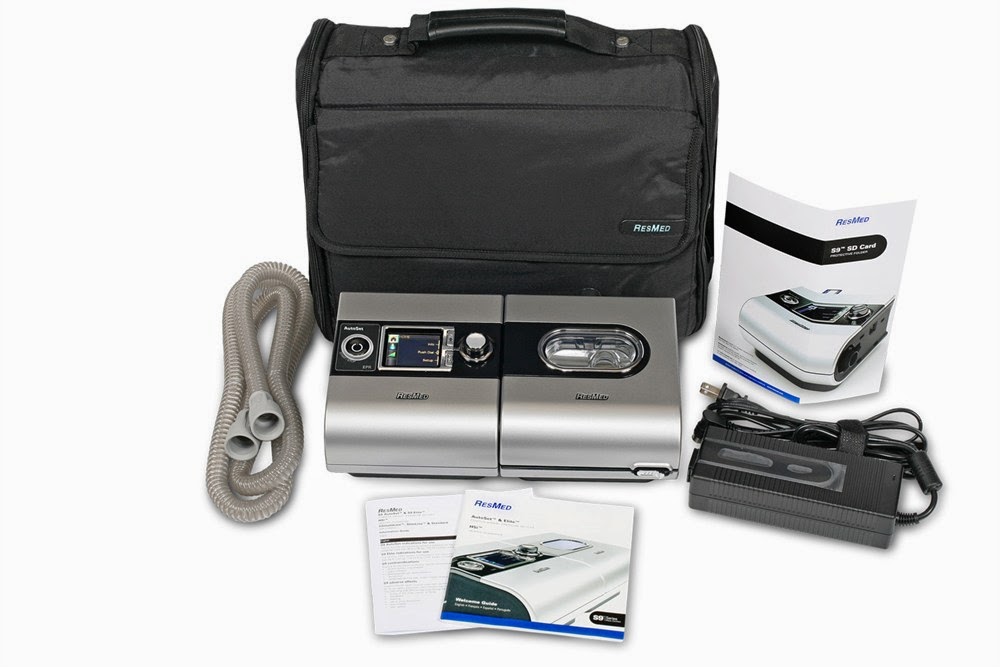
ResMed S9 Autoset
So, after being diagnosed, on November 11, 2013 I got my very first CPAP machine (Continuous Positive Airway Pressure), a RedMed S9 Autoset with H5i heated humidifier an an oh-so-sexy full face mask (a ResMed Quattro FX for her). A CPAP machine is continuous air pushed from the machine, through the hose and into a mask (I have a full face mask but there are other kinds). This air is set to a level that is enough to keep your airway constantly open which should result in a better nights sleep (no more waking up to breath) and also a better nights sleep for your sleeping partners because the snoring stops!  Some people really struggle with their machines, especially in the beginning, while they get used to having a mask on their face.

Quattro FX for Her
I've had my CPAP machine now for just over 5 months. In the beginning I really struggled (though I still slept pretty well really) with changing my sleeping position and being more aware of now rolling onto my side and burying my head in my pillow. When I do that it nudges the mask and air escapes, making this annoying hissing sound and blowing into my eyes.

I found the change in sleeping position hard on my back but I've adjusted now and am still able to sleep on my side as well as my back. It's pretty funny really that I sleep on my back, often considered the worst snoring position, because I'd spent so many years avoiding doing so to lessen the snoring.

Some people report feeling congested or dry mouthed in the morning, even with the humidifier, but while I've noticed a difference, it's not to an uncomfortable level.

Cost wise, we got the machine through insurance and had to pay co-insurance (our deductible was paid thanks to the sleep studies). I will address how health insurance works (in general) in another post.

Anyway, there you go. My first big experience with the US health system.

Thanks for reading!

**Edit - I forgot to add, my husband sleeps much more soundly now I have the CPAP machine :) I still snore on a bad night but he said it's not very constant and is also muffled by the mask so it doesn't bother him! The exhaust sometimes blows on the back of his neck though, or he hears the hissing when the mask shifts and leaks and it will bother him but the benefits far outweigh the occasional issues!

Tuesday, May 6, 2014

Cinco de Mayo - Mexican Celebration

Celebrate Cinco de Mayo!
Monday, May 5, 2014 was Cinco de Mayo which quite literally means "fifth of May" in Spanish.

Here in the US, Cinco de Mayo is celebration of Mexican heritage and pride, but you don't get the day off work!

I admit I was confused my first year here... it's not like America celebrates Australia Day or any other countries "special days", so why are we celebrating a Mexican holiday?

My source of confusion it turns out was due to misinformation. I had been told that it was "Mexico Independence Day" but it's not (that's in September). Instead, it commemorates the Mexican victory over the French at the Battle of Puebla on May 5, 1862, where the Mexican Army won the battle despite being smaller and ill-equipped.

Spanish dancers
Cinco de Mayo originated during the first years of the Civil War in Mexican-American communities living in the American West (California specifically) to celebrate freedom and democracy.

In many cities in the United States, there are parades and festivities featuring mariachi music, dancing, and Mexican food (mmm nachos!).

The celebration is actually a bigger deal in the United States than in Mexico and has become a drinking celebration here in the U.S, apparently nicknamed Cinco de Drinko and even Gringo de Mayo (though to be honest I haven't heard either of those nicknames, I hear a lot of people talking about getting drunk on tequila and margaritas). In Mexico, Cinco de Mayo is observed with political speeches and battle reenactments.


I don't celebrate Cinco de Mayo myself but I did have enchiladas for lunch :)

Sources:
- http://en.wikipedia.org/wiki/Cinco_de_Mayo
- http://wqad.com/2014/05/05/understanding-cinco-de-mayo/

Wednesday, April 23, 2014

Easter 2014

I blogged about Easter last year (post here: Easter - Holidays, Candy & Toys) but as time goes on and I learn more, I want to blog again, so here goes.

As with last year, we didn't have Friday or Monday off but we did get to finish at noon instead of working all day. As discussed in my previous blog, toys and candy, rather than chocolate, are the typical gift received by kids here. This time though I was able to take photos (at my local Wal-Mart) of some Easter Baskets available for purchase:

Wal-Mart $5 baskets
Wal-Mart $15 baskets
Wal-Mart $20 basket


Easter Candy
The baskets aren't very expensive, as you can see by the price signs, but I'm not 100% sure I'd buy one of those instead of making my own up. They do seem good for if you have lots of kids to buy for though... just grab and go.

It seems to me though, from seeing what other people have posted or blogged about, that many prefer to buy an empty basket and buy their own fillers. Fillers can be anything from clothes, to crayons, DVD's and almost always some candy.

Candy, as explained in my other blog, is usually just regular candy that's available (M&M's etc) but it's packet would have been changed to include Easter themed things (like rabbits or eggs or chickens etc) or spring colours. Peeps (the yellow things at the top of the photo to the left) are synonymous with Easter. You might be able to find them all year but I can't say I've looked!

This year, for myself, I had a Godiva egg and some Russell Stover rabbits for Easter (4 in total but I had eaten one before the below photos were taken :P). The rabbits were less than an inch or so thick and one was filled with caramel, one had little "crispies" in it, one was "cookies and cream", and the other was just solid chocolate. All yummy  :)

Godiva egg
Russell Stover rabbits


I was actually pretty pleased to find the above kinds of chocolate. The Godiva egg was the first hollow egg I'd seen (had to be bought just for that!) and both are kinds of chocolate that I like. This isnt going to be the end of my Easter gorge though, mum is sending me some hollow bunnies and other lollies with a friend that's visiting in a couple of months so I'm really excited about that as well!

Easter Lily
I also saw a Lily for sale at my local grocery store labelled as an "Easter Lily". As you can see from the photo it looks like a regular Lily but with a little rabbit stuck in it. It was a decent size and from memory was being sold for $20.00. I didn't buy one (by the time I saw it it was Monday so there was little point) but I have been thinking about getting one as a house plant... we'll see!

The other thing I noticed more this year (most likely I wasn't paying attention before) were Easter Egg hunts! Lots of different organisations have their own hunts with different prizes or charities involved. I saw another one in the news where it was for adults only and the winner won a car!

This year, on Easter Sunday, my husband and I had lunch with his Aunt, Uncle and his cousins and that was good too. We had ham, mashed potato, buttered corn and bread rolls. Some of the others had stuffing and brussel sprouts but not me! For dessert we had a choice of cheesecake, apple pie and fudge (the latter of which I made - that should be in another blog!). It was good to catch up.

Anyway, there you go. Easter 2014 done and dusted!

Saturday, April 12, 2014

Dawn of a New Theme...

Swifts Creek
(pretty, but nowhere near me)

It's been a while (well okay several months) since I last posted and I'm sorry about that but I've been finding it a little hard to find topics to talk about.  That's not to say I don't have some to post, I do, just in draft form, the problem is some of them require a fair bit of research and preparation so I thought I might try posting about life here in a more personal way. 

I will still continue along the same vein as previous posts (the difference between the US and here) but in a more personal "how this affects me" way. As time passes on life here, it's hard to remember what is and isn't in Australia, and because it could be there now and I'd have no idea!

I truly hope you enjoy this change and I hope this will mean I will be able to post more often (or at least have something to ramble on about more often!).

Monday, November 11, 2013

Becoming a US Citizen!

It's been a while since I've written a post and I thought the next post I wrote should be this one... because after one visa, a travel permit, a work permit, two (2) greencards, 4 years and a fair bit of money, in September this year, I BECAME A U.S. CITIZEN!

Many people I've encountered since I began this journey thought that becoming a US citizen was as simple as marrying my US citizen fiance (I can't say I blame them... movies and books don't exactly help) so I thought some of you might enjoy a little walk down memory lane with me (headache included free of charge!).

My path to US citizenship included four (4) main stages:
  • K1 (fiancee) visa
  • AOS (Adjustment of Status) aka Conditional (2 year) Greencard
  • ROC (Removal of Conditions) aka Unconditional (10 year) Greencard
  • U.S. Citizenship

I'll start with a quick disclaimer: Not every situation is the same, or as easy, or as hard, or as involved. It really depends. So please don't take this as "gospel" for your personal situation.

You can sign up for "status updates" on each of these stages but it's never very detailed. It's usually just something like "acceptance", "processing", "information requested" and "decision" and unless it moved from one of those categories, you wouldn't know anything.

K1 (Fiancé/e) Visa

A visa! Also known as "permission to enter the US". In the case of this particular visa, it is a (non-immigrant) permission to enter the country with the intention of moving there (for example - you can't just move to the US on a visitor visa... that's immigration fraud). If you're a private person who loathes giving out personal information about yourself, immigration is not a process for you! Just from this part of the process they know EVERYTHING about you. There is no hiding. There are no secrets. This is only the beginning...

I wasn't even allowed to apply for the visa until my fiance had first filed for (and was granted) permission for me to apply. He/we had to prove we had the intent and legal ability to marry (so siblings couldn't apply and neither could people who were married etc). We didn't really have to show much relationship evidence at this point, but this stage (permission for me to even apply for a visa) took almost 5 months to approve. Just a lot of waiting, waiting, waiting...

Once I had permission to apply for the visa, I had to send:
  • Visa application forms (plus fee) - which including telling them everywhere I had lived (and when) since I turned 16 (thank goodness mum kept a diary 'cause being a Uni student, I moved a LOT!) and everywhere I have worked (some places are better forgotten!);
  • Financial support forms - My US citizen fiance needs to prove that I won't become a financial burden to the USA by way of showing they have enough income to support you. So he had to show things like bank statements, tax returns, pay stubs etc etc... There is a minimum that can change every year;
  • Fingerprint police check (from every country/state I had lived in for more than 12 months since turning 16); and
  • Medical - including a physical, blood tests and immunizations (at the time of doing my medical there were only two doctors authorised to do this particular medical and forms in the state of Victoria, now I'm told there is only one).

After submitting all the information I had to wait to be called for interview... the final step. The only location to interview for the fiance/e visa is in Sydney, so people flew from all over the country to attend.

I had my interview in August and the day of the interview SUCKED! I tripped on the way to the bus and smacked my face on a railing (super sexy), had my flight cancelled once, and the replacement delayed twice. Landed well after my interview was scheduled to start (I had typed a rushed email to them from one of those internet terminals while I was delayed) and while hanging out in the air waiting for a place to land (only one runway in Sydney was open) I thought all our waiting and time had been for naught and got a ... tad weepy. I was bruised, stressed and late... But they knew all about my delay and replied to my email while I was in the air (got it once we landed... yay smart phones!) telling me I could just do my interview whenever I got there.

Once I was at the US Consulate it went well. I waited to be called up to one window to give an officer some items they had requested (envelope to ship my passport back to me with the visa in it for example), and then wait again for another officer to call me to have my fingerprints taken. Then I took a seat in a different section and waited until I was called for my one-on-one interview with an officer who asked questions about our relationship (how we met, where he works.. that sort of thing).

You need to take relationship evidence with you so I took proof of emails, chats but my interviewer didn't ask to see any relationship evidence. There are some instances where the interviewing officer has asked for email or facebook logins and passwords but he didn't ask for any passwords or anything like that. I only mention the password stuff to further explain what I said earlier - no secrets. Approval isn't a guarantee. This isn't just an "apply and you'll get it" process. There is a genuine threat of denial if they don't believe that your relationship is legit. You can try and appeal, you can re-apply, there's another type of visa you can apply (and pay) for... but no guarantee of approval for them either.

My visa was approved on the spot but I had to wait for it to be generated, stuck in my passport and then mailed out to me, so after a quick lunch at a Sydney cafe, I traveled back to my home town to wait for the mailman.

Once I received my visa I was free to leave, so in early September I packed my life up into 2 suitcases (and 2 carry-on), left what I didn't urgently need in boxes that stayed in Australia and I moved to the U.S.

The visa is a single-use visa that is only valid for 6 months and once I had entered the US I had 90 days to marry (and 90 days of legal status). So in November 2009 we were married in a small white wedding ceremony with his side of the family (plus my sister and her husband who flew over to attend).

Some people complain about the 90 days "how do you plan a wedding in such a short time" and honestly, not many people CAN plan the "big white wedding" while in another country... especially when your entry date is NOT guaranteed (there is no promise you'll get the visa, and by when) and a lot of places charge a fee to change dates or cancel. A lot of people do a courthouse wedding, and then do the "big white wedding" later in the year when they've had time to plan. I organised our wedding from afar with some assistance from my fiance's family, finalised the details when I arrived, and bought the decorations in the week before the wedding. Stressful! I don't advise the same!

Adjustment of Status (AOS) aka Conditional (2 year) Greencard
Permanent Resident Card
Redesigned May 2010


The AOS process includes:
  • Adjustment Application Form (plus fee);
  • Medical - ensuring your immunisations are up to date and medical still valid;
  • Financial Responsibility form; and
  • Relationship evidence isn't required to be sent with the paperwork, this early in the "game" we don't really have a lot to show anyway, but many people are asked for it in the interview (if they have one, not everyone does). I sent a small amount of evidence in the hopes of avoiding an interview.

The simple act of marriage does nothing to protect your legal status in the US. Your visa expired on entry (single-use and all that) and gave you 90 days of legal status. After that, you cannot legally work or drive.  If you leave the country at any point after entering on the K1, and without a greencard (or travel permit) you will be unable to easily return to the US (you will need another visa usually) so you need to do something about it.

That "something" is to file for Legal Permanent Residency, most commonly referred to as having "a greencard". So in early 2010 we filed for the Adjustment of Status (AOS). The final outcome of the AOS process would be a 2 year conditional greencard (which includes permission to work and travel and the condition being your marriage to your USC spouse) but given that the process can take several months, it is common to include the application for work permit and travel permit with the AOS paperwork so you can work or travel outside the US while you're waiting to be process for the greencard.

About a month after filing we had to drive to our "local office" (actually it's 3 hours away... one-way) in Des Moines for an appointment to have my fingerprints taken, have a passport photo taken (this horrid photo is the one they used on the work permit and the greencard :S) and to answer questions about height, weight, hair colour etc,. The appointment only took about 15 mins... long drive for such a seemingly small thing (though in reality your case can't progress until it's done).

Two months after filing for the work and travel permit they were approved (no interview is required for these). Some people need the work permit to get a drivers license but I had no need to use them just yet.  It was good to have them though just in case of an emergency (especially the travel permit).

Around a month after that (3 months from filing) I received an online notification telling me my greencard (or Permanent Resident Card) was approved. I was one of the lucky ones that wasn't asked for more relationship evidence or asked to attend interview.

Aside from being approved without interview, I was one of the lucky ones in regards to the relatively short approval time. Some people I know waited well over 6 months. Some people had been sent request to send more relationship evidence and in the year following my approval the waiting time got even worse for some.

The greencard was valid for 2 years AND now I had a "deadline" to worry about (the expiration date). If we missed filing before the deadline/expiration, my greencard status could be revoked and I could face deportation. Stressful!

Removal of Conditions (ROC) aka Unconditional (10 year) Greencard 

Filing for ROC consists of:
  • Application form (plus fee); and
  • Relationship evidence - a lot of it, spanning the entire length of the marriage
The ROC deadline was a timeframe in which I had to file for Removal of Conditions (ROC). Ninety days before my card expired my "window" opened (I wasn't allowed to file early or it would be rejected) and before my card expired I needed to send in MORE paperwork with A LOT more relationship evidence and again we may have needed to be interviewed.

For the two (2) years following the approval of my greencard, my husband and I had to ensure that we kept all the evidence of our relationship. This included any leases, bills, cards, bank statements, photos, etc and we then had to send that evidence (not just one months worth, or recent, it needed to span the entire marriage... without being ridiculous) along with the ROC form.  Some people totally overloaded their forms with evidence... which you would *think* was a good thing, but instead just resulted in them being asked for more specific information, or an interview.

Once again around a month passed before we had to travel to Des Moines for the fingerprinting and photo appointment... then just waiting...

This time it took more than SEVEN months to hear anything from immigration. During this time there are numbers you can call, but they read from a script and you aren't likely to learn much except "it's still processing". I also have to admit there's this fear (irrational or not) of rocking the boat too much and ending up with your pile delegated to the "too hard" or "when I feel like it" pile and having to wait longer... so you try really hard to be patient...

As with last time... you can interview, receive requests for more relationship evidence, one, both or neither. I didn't have interview or need to send more information and instead just one day received an update online telling me I had been approved (having registered for online updates).

This time I received a greencard that was valid for 10 years. It looks exactly the same as the conditional card except this time there are no more "deadlines" I need to worry about. Even if the card expires, as long as I haven't abandoned my status (there's a whole bunch of rules about that) then I can just renew it when I can... though I wouldn't have proof of my legal status so letting it expire isn't the smartest idea, but at least I would still be legal (unlike if the conditional one above had expired).

-----

For many people getting the 10 year greencard can be the end of their immigration journey. Their country may not permit them to keep their home countries citizenship if they become a US citizen so they remain Legal Permanent Residents (LPR's) for life.  There aren't many restrictions, mainly the inability to vote in a Federal Election and unable to serve on a jury. The only other important issues is having to do things to preserve their status (unable to stay out of the US more than staying in for example), some jobs being unavailable to them because they need citizenship for it, and if they're convicted of certain types of crime they're deportable... but mostly life can be relatively normal.

Fortunately I have no restrictions on having multiple citizenship/nationalities. So...

Naturalization Certificate - sample
U.S. Citizenship

Filing for US Citizenship consists of:
  • Application form (plus fee) and a few supporting documents (copy of tax returns for example to show we file as married)... that's it.
There are two different ways to be eligible for citizenship:
  • Being married to a US Citizen 3+ years AND an LPR for 3+ years (usually at the same time, so after 3 years); and
  • Being a LPR for 5+ years

I personally filed based on the first option, being married to a USC citizen and being an LPR for 3+ years. Simply being married to my USC spouse wasn't enough, I had to be in a relationship with them too (sounds like the same thing but for some people who stay married for the convenience, it isn't).

I filed the paperwork in April of 2013 and as with the other processes, we drove to Des Moines for a 15 minute fingerprinting and photo appointment. This time I was given some material to review because I was going to have to learn about America and take a "civics test" at my interview (which was a guarantee this time).

Just over 3 months later I had an interview in Des Moines. After a little up-and-down in the elevator (we had to go to the second floor to be sent back down to the first floor), we took our seats and I waited to be called for interview (my husband was there with me but would not be interviewed).

The interview began with the officer going through the form, double-checking my answers to questions, checking my passports (new and expired) to make sure I hadn't abandoned by greencard by staying outside the US for too long, and then she got to the "testing" potion which consisted of two main parts:
  • English (speaking, reading and writing) - I was also asked to read a question written in English off a piece of paper and then I was asked to write the answer (which I was given) also in English; and
  • Civics test - consisted of being asking 10 questions out of a possible 100, and I had to get 6 right.

It took a very short time (maybe 1/2 hour max including the time spent going through the form to double check nothing had changed since I filed) and she said I was recommended for approval and I needed to wait for the last and final portion, the Oath Ceremony.

Although I was approved for citizenship, I was NOT a citizen until (and unless) I took the Oath Ceremony. The waiting began again and just almost 6 months from filing we returned to Des Moines for the Oath ceremony and on that day, I BECAME A US CITIZEN!

And that's it. It's finally done... well... I still need to update the Social Security Administration and the DMV and get a passport... but I can call myself a US Citizen to anyone who asks (which is odd for me because I've spent years making sure no-one thought I was a US Citizen, it's the death knell for immigration if they think you pretended to be a citizen when you weren't).

This is not a process for the faint of heart. It took quite a few drafts of this post just to get it to a point where it was (reasonably) easy to understand. This process is hard, expensive, and time and thought consuming. It can easily go wrong if you're complacent. Some people sail through, some people struggle at every turn. Such is the price we pay to be together with our loved ones, in the U.S.A.

Wednesday, July 31, 2013

The Bill of Rights & Amendment to the Constitution - First Amendment

This topic has come about because lately I've heard a few of these used, and some mentioned by people from other countries, and I'm not sure many people *really* know what the Bill of Rights or amendments to the Constitution are, and what these mean for life here, so I thought it was a good topic for a blog.

We get enough American TV in Australia (and other countries) that I'm sure all of us have heard some of the amendments for the Constitution already: Freedom of Speech, Freedom of the Press, "I plead the 5th" etc, but what do these really mean?

Well firstly, the Constitution is the law of the land in the United States. Every rule eventually leads back to the Constitution and people take the Constitution, and the rights it conveys, very seriously (as they should). There are 27 amendments to the Constitution and the first 10 are referred to as the Bill of Rights. Because there are so many amendments, and because they're not just small phrases, it's not as simple as just listing all 27 rights so here's the Wiki article for those interested: https://en.wikipedia.org/wiki/United_States_Constitution#The_Amendments but in short, amendments to the Constitution, such as the Bill of Rights, explains some freedoms not fully explained out in the Constitution.

The First Amendment is the one I wanted to talk about for this post. The First Amendment deals with "individual rights" such as (the titles are hyperlinks to Wiki articles for more information):
  1. Freedom of Religion - the right to practice any religion, or none at all
  2. Freedom of Speech -  the right to communicate opinions and ideas using one's body and property to anyone who is willing to receive them
  3. Freedom of the Press - the freedom of communication and expression through mediums including various electronic media and published materials.
  4. Freedom of Assembly - the individual right to come together and collectively express, promote, pursue and defend common interests
  5. Freedom of Petition - the right of the people...to petition the Government for a redress of grievances
Contrary to popular belief, Freedom of Speech doesn't mean you can say anything you want and there should be no consequences. That is an extremely popular misunderstanding of what it really means and you will read it anywhere someone is fired for posting stuff about work, or posting public opinion being held against them at work, or people being sued. People crying out that they shouldn't be fired/sued/held accountable because it's "Freedom of Speech".

As you can see from the explanation, the term "to anyone who is willing to receive them" is extremely important. There are limitations, such as: defamation (saying something false to damage someone's character), or libel (accusing someone of something they didn't do), racist remarks or copyright violations.

Likewise, with "Freedom of the Press" it doesn't mean they can say whatever they want either. Certain information such as private/classified information is off the cards.

Basically, these rights are here, these freedoms are here, but all with moderation and respect.

Wiki about the Bill of Rights: https://en.wikipedia.org/wiki/United_States_Bill_of_Rights
Wiki about the Constitution:  https://en.wikipedia.org/wiki/United_States_Constitution

Tuesday, May 28, 2013

A Year Ago Today...

A year ago today (almost to the day) I made my first post so this is quite the anniversary for me!

This blog started off like most probably do, with people asking questions about my life here and wanting comparisons to life in Australia. I don't know all the answers (surprisingly :P) and it led me to researching and later, to blogging about my findings. Sometimes I'll see something funny, or tell someone something they find funny or strange and I come here and leave little drafts/notes for myself of things I could/should write about.

You have probably noticed by now that there seems to be no rhyme or reason to my post dates and to be honest, it's because sometimes I struggle with finishing off posts.  I have many posts sitting in draft form just waiting for me to get the drive to finish them. Some might say I'm a bit of a perfectionist but it's probably more that I babble on too much and it's hard to cut it down to make sense! I will work on a post for a week. This one for example I actually started 5 days ago and am now just finding the time to work on it...

Hopefully though you guys don't mind the random dates of my postings and will continue to read on anyway :) I would also like to involve you in my blog and in the spirit of my One Year Anniversary, I would like to encourage my readers (if you're out there and so desire to) to ask me questions or suggests topics that you would like me to give my two cents on or look into.

Thank you for reading! I do read all your comments and thank you all for your feedback :)

Wednesday, April 24, 2013

Easter - Holidays, Candy & Toys

Large Aussie Easter Eggs
You read that title correctly... candy and toys, not chocolate, is how Easter is celebrated here in the US, that is IF they celebrate Easter at all. (Again please remember this could be specific to my area so no offense to anyone who celebrates differently!) It's not only candy/chocolate that's different either, it's also the manner in which it is celebrated, and the Easter holidays themselves.

This Easter, like the ones before it, I was jealous. Posts all over Facebook, people talking about their four-day weekend in Australia and me, I had work both Friday and Monday. Easter is supposed to be four days of relaxation, family time and chocolate comas... not in the US!

I was talking to a friend on Friday morning as I was getting ready to work and she asked me why I was up so early on a day off, that she would be sleeping in. When I told her I was getting ready for work she was confused and asked me if it was Friday here. When I told her yes, but it's not a Public Holiday... well... she had some choice words to say so I thought it would make a good post to explain WHY :)

I'm sure a lot of you are aware that Americans in general tend to be quite religious, so you would think that the US would have a religious holiday such as Easter as a public holiday... BUT the US is also big on separation of church and state and also Freedom of Religion (the freedom to pick any religion or none)... so having a religious holiday as a public holiday is a no-no because that would be "forcing" people to participate in a religious holiday.

Now, don't think that means you CAN'T have those days off, you can tell your employer that you are taking that day off as a religious holiday and they cannot refuse you (discrimination issue and all that), and apparently quite a few people do this. Some government agencies (like the court house near where I work) elected to close on either Monday or Friday, businesses can choose to close or not close, but it's not "mandatory" like some holidays are (there will be another post about the different kinds of holidays to come).

I asked my work colleague about schools as well (as she actually has kids, I do, but just the furry and scaley variety :P) and she said that as Spring Break is around the time of Easter, some religious schools will time Spring Break to start on Good Friday so that they have the Easter weekend off as well as the regular time off for Spring Break (which varies by school, no set period), which averages about a week off.

Easter basket for young kids


Easter Basket
Easter Basket for the older child


So now we come to candy and toys. I was able to get a few photos of Australian chocolate (many thanks to friends and family!) but because I don't really know that many kids here, I didn't get any of Easter baskets  (so I borrowed some pics from online) but in short... kids don't get chocolate like we do. No chocolate comas for them. No giant chocolate bunnies and giant eggs about the size of your head. That's just unheard of. Here in the US, you get an Easter basket. Quite literally a basket (usually in Easter colours - pastels) that has toys in it, and often with some candy (skittles, M&M's etc) thrown in.

Large Aussie Easter eggs!
 The Easter candy/chocolate here does not even compare to what is sold in Australia over Christmas. Here they have themed items, like Easter coloured M&M's, or the shapes of bunnies or eggs in regular candies (like egg shapes Reeces Peanut Butter Cups). You'll get skittles, or pop rocks, peeps (they are little chick shaped items) and a whole slew of other candy, just Easter themed. I believe it's around now that you start seeing chicks and ducklings for sale in some farming stores too.

It's not that Easter here is BAD or anything. It's just one of those holidays that for 26 years I was used to celebrating a certain way and was, quite honestly, disappointed that I couldn't get my head size eggs and other Easter chocolate like I could in Australia, it just did not seem to be as big an event as it most definitely is in Australia. I know a lot of ex-pats feel this way their first Easter as well.

One of the things that a lot of these differences do is make me wonder when the time comes, if we have kids, what sort of traditions are we going to pass on? Would our kids appreciate having Easter treated more like the Australian Easter where they only get Easter Eggs (lovingly imported from Aus that is :D)... after all, they get candy on Halloween, and toys on birthdays and Christmas... or will they hate that they're "different" from their friends? The same goes for any of the other Australian holidays. Should we celebrate Australia Day? Should we tell them what the Melbourne Cup is? Should we explain that Thanksgiving is an American holiday (and Canadian but a different date)? Where is the line between TOO different, and just different enough? Maybe just having a mum that talks funny will be enough :P

Monday, March 18, 2013

Money!

Exchange rate Feb 20, 2013
I think we've all seen enough of American money in the movies to recognise it when we see it, but I thought some of you might enjoy a quick comparison to Australian money, and also to learn a little bit about money here in the U.S.

To start I thought I would address a few quirks about Australian money, for those readers who aren't from Australia so you know exactly where I "came from".

Australian Coins
First, in Australia we have done away with 1c and 2c coins. This was many moons ago while I was still a kid. The smallest coin in Australia is now the 5c coin BUT you can still sometimes see prices as, say, $1.88. Now we don't do the 1c or 2c so we can't give coin up to 88c but neither can the cashier give 2c change. If you pay with card (EFTPOS in Australia) you will be charged exactly $1.88 BUT if you pay with cash, you will pay $1.90. It gets rounded down or up depending on whether it's closer to the next 10, the previous 10 or 5. At first people were worried they would be cheated out of money with the rounding up but really it most likely evens out, plus, you can just use card (which is VERY prevalent) instead of cash, problem solved :D

Australian Notes
Australian notes are made of a polymer so it feels very plastic. You can cut it with scissors but getting it wet doesn't damage it. A bad thing is though that when wet it's possible for them to stick together, and sometimes even if dry by static, so you could accidentally give someone more money than you intended! The notes also have a few safety features, mostly watermark type things, so you can tell if it's real or fake.

The best thing about Australian notes, in my opinion, is that they're colour coded. So when you look in your wallet you can tell by looking at the colours how much money you have in your wallet! A lot of people call Aussie money (and UK money) "monopoly money" because it's so multi-coloured and to them, looks fake.

American Notes
American money is basically paper (though a special kind) and very easy to tear and if it gets wet it can destroy it (however it's not uncommon to see notes taped back together!). Occasionally you will hear someone refer to American notes as "greenbacks" and this is of course because they're green, or rather they used to be. Like Australian money, American money is starting to become coloured, just not quite as BRIGHT as Australian notes! I still find it hard to identify how much I have in my wallet though, and I'm sure I'm not the only person to open it up to see a few notes and think I'm rich, only to find out they're $1 notes :P

American Coins

Similar to Australia, America has coins that are being used less often to the point you may never see them (unlike Australian 1c and 2c which are now totally obsolete), these are the 50c (half dollar), $1 coin. They also have the $2 note which you won't see too often either. You can still find some of these, but they're not common.

Both Australia and America have slang terms for particular notes. Not everyone uses the slang (me for example :P) but you might hear certain things from time to time like "redder" for a $20 note in Australia (because it's red) or "Benjamins" for $100 notes in America (because Benjamin Franklin is on the note). This wiki link: http://en.wikipedia.org/wiki/Slang_terms_for_money has more examples (though I'll admit some of them must be old because I've never heard some of them! Like I said, personally I don't use the slang terms, not when "10" is so easy to say but doesn't mean you won't hear them some time!

Both countries have security marks/features in their of course, BUT here in American there is a special marker/texta! The first time I saw someone take out a marker and scribble on a note I was confused when nothing came up. I wondered why they were testing if a marker worked, on money! That's when I asked and found out about the "counterfeit detector pen". Here's a "How Stuff Works" link to explain: http://www.howstuffworks.com/question212.htm  Basically if the money is fake, the marker will show, if it's real, nothing happens :)

It did take a while for me to get used to the differences. It's still weird to me to have so many ones ($1) in my wallet but I know other people that find it odd to have "big money" (anything with "dollar" after it being "big") as a coin, especially as they're not light! A lot of American men carry the "change" in their pocket as well and someone I know went over to the UK and ended up carrying a fair bit of money in their pocket not realising they had $1 and $2 coins in there! It's also still weird to me that the American 5c piece is the size of an Australian10c piece, and the 10c piece is the size of an Australian 5c (roughly)... not to mention all the pennies!

** I'm sorry this one took so long to get out! I'm actually working on a few at the moment, and the Health Care one specifically is difficult to make sure I make sense (when sometimes the healthcare here doesn't make sense!). So stay tuned! I'm going to try and get some of the "easier" ones out first and continue working on the Health Care one :)

Tuesday, January 29, 2013

Seasons - Weather & Shopping

01/21/12 - Temp in F
01/21/12 - Temp in C
This is a post I've been thinking about for a while because it was of course one of the first things I noticed, the difference in weather!

In my area of Australia (I'm just gunna say "Australia" for this post to save time but yes, I know it's hotter in QLD, NT and WA than in Vic :-P) it was basically HOT (Summer), warm (Autumn & Spring), and cold (Winter)...  Cold was anything under 20C (and I don't remember anything under 0C) and sometimes at night it would get down as low as 1C and that was just the world ending! But most of the time it basically felt like we only had two seasons... either warm, or kinda cold.

Foliage wise too, nothing really changed. I didn't noticed the plants really obviously dying off then "springing" back to life like I do here in the US. I noticed Autumn of course but we must just have a lot of evergreens near my house because I never noticed an extremely large amount of leaves. Everything basically stayed green all year round until it went brown in the heat of summer.

In a lot of towns here there's a "dumping" area for plants, lawn clippings etc so this past Autumn (okay it's called "Fall" more often in the US) we scooped them up and dumped them there. SO many leaves, about 4 truck-bed's full and it was a lot of work and I definitely felt it the next day!

Here in Iowa we definitely have all four seasons. Summer is HOT, Autumn is warm with the occasional cool breeze (and the leaves falling etc), Winter is FREEZING with snow, and Spring is warm but wet with all the snow melting then all the grass comes back green, and flowers bloom.

Summer gets ridiculously hot here in Iowa, but a humid hot which I personally think is worse in some ways and better in others. The dry heat in Australia is good in that you can often stand in the shade and not feel as hot, but this also means the risk of bushfires is greater. Here in Iowa there's no hiding, it's hot EVERYWHERE. The good thing about that though is window unit air conditioning units are really reasonably priced and actually really efficient. We have central air-conditioning as well (very spoilt) so our house is basically climate controlled which is wonderful :-) My husband once told me that it gets so humid because of all the crops (corn and soy) that boosts the moisture in the air.

It was only after my first full (and proper winter) when I finally realised what "Spring Cleaning" was and why it was necessary. Over Winter the house is all shut up of course and sealed with the heater running (in our case central heating with a humidifier running because the dry air from the heater makes me so itchy!), that's a lot of recycled air. When Spring hits you open all the windows and let the air circulate. You clean EVERYTHING to get rid of that "sealed up" and stale feeling and you throw out stuff you'd just been storing because you really don't want to go out for longer than you have to!

With the weather came another realisation, I don't own enough clothes! Well.. okay I didn't own enough variation of clothes, not to contend with the weather anyway :-P

I have to admit back in Australia I basically wore the same thing year round (only adding a jumper when cold) because the temperature didn't really alter all that much... pants (jeans) and a t-shirt... so I didn't really understand in movies how they would "pack away" clothes or buy clothes in seasons ("this is my winter wardrobe"). Why would you pack them away? Why would you buy multiple seasons of clothes? Seems a little pointless and expensive... WELL, now it all makes sense! I store my heavy winter coat, snow boots, beanies, winter gloves, long sleeved undershirt and all that because you only need it for 3 months of the year. As it starts to get cold you get those clothes out of storage, move your colder weather clothes to the front of the wardrobe and the summer clothes to the back.

That of course leads to SHOPPING for seasonal shopping. My jeans broke last summer and I went to go buy a new pair from a store I like to shop in and all I could find were capris or shorts or skirts but not a good range of full-length jeans. I had to wait until they came "back in season" before I could get proper new ones. I had to get cheap jeans that I hate but at least did the job.

I broke my sunnies last week and found out that those are seasonal as well, and found out my favourite shopping store (Kohls) is a seasonal shop so NO sunnies :-( Ended up located my sunnies (same as my broken ones) at Wal-mart. Thank goodness for Wal-mart hey!

They talk about times of the year in terms of seasons too. "I'm going to college in the Fall", movies are "out this summer"... I have to admit it takes me a second or two to calculate that :-P

Sunday, January 6, 2013

Pop Can & Bottle Recycling... For Money!

Okay so I found it hard to find a heading that didn't just make it sounds like I'm talking about typical bottle and can recycling that we do in Australia, so hopefully you guys were attracted by the word money as something interesting/different and read this post! It's only going to be a short one (you all probably have realised by now that "short" is a relative term!) but seeing it's something I did today I thought I should get it out there before I forgot! As a heads up I'm probably going to use the term "can" a lot but assume I'm talking about bottles as well :D.

Today I took 240 cans to the "can center" and in return I was paid $12. Now you'd be forgiven for thinking I actually got paid to recycle, but that's not actually the case... not entirely anyway. I'm not profiting, I'm actually breaking even.

How's that you ask? Well, I can't remember whether it's the same in Australia, but cans and bottles here have this weird looking writing on them that usually includes a monetary amount like 5c or 10c. It's actually state codes with how much of a deposit you pay for the bottle or can. See pics below (p.s. the can one was a really hard photo to get clear!):

Soda Bottles Deposit/
Recycling codes
Codes on the cans
Receipt Showing Deposit Paid


So you can probably see that there are only a couple of states that are listed (CT, IA, HI, MA, ME, NY, OR, VT for 5c, MI for 10c and CA says CRV explained here http://www.calrecycle.ca.gov/bevcontainer/ ). This means that if you buy a bottle or can in those particular states, you will PAY a "deposit" when purchasing the beverage (see my receipt above).

In order to get that deposit back you need to take the bottle or can to a redeeming center. Apparently legally the place you bought it from is supposed to accept the can back, but not all places are equipped to deal with it so will only take a 12 pack or a small amount, if they take any at all. That's why they have the "redemption centers".

Rules for Redeeming
There are rules for redeeming cans and bottles as well. The place I went to today gave me a list of rules (to the left). Every place probably has different rules. The place I used to go to (that has since closed down) would take 240 cans or 300 cans. You were paid 5c per can. Now here's the thing. They never actually counted the cans while you were there (that would take too long because it's by hand) so instead some places will go by the "height" of the bag (because the can bags are pretty standard in size/width and yes we usually pay for them, 75c at this new place). I actually found at the old place they didn't pay me for the 300 cans but I didn't know that at the time, it wasn't until I got home that I was told I should have been paid more ($15 as opposed to $12) which isn't a lot but can add up over the years!

At the new place they don't count them either but the lady told me they will only take 240 cans (or rather only pay for 240 cans but you can give them more, just won't be paid more) because people were cheating them and saying there was 300 when there was less. They trust you to have the right number of cans in the bag until you prove to be untrustworthy. She also told me that the companies who make the pop are the ones that pay them for the cans. They are paid 6c per can, they pay us 5c per can so their profit is 1c per can. Apparently since the old place closed they've been EXTREMELY busy handling the cans and have needed to hire on someone new to help (she told me that earlier that week in one day they had well over 70 people come in so $138 profit assuming all the bags were exactly 240 cans and not including bottles etc).

Processing the cans at the can center consists of people opening all the bags and sorting them into bags for their respective manufacturer to collect (and people don't tend to wash them so it's really sticky) . When I dropped off my bag there were 2 people sorting cans and there were a LOT of bags to sort. It'd be pretty good repetitive arm exercise though... I know because I had to sort through my cans into bags of 240. Fun fun!

On doing some research for this topic I actually came across some posts that talk about "can counting machines" that you empty your bag of cans into and it spits out a receipt that you take to the cashier who will give you the money for however many cans are on the receipt... of course I also read that homeless people camp out near some of those places and beg people for their receipt (but homeless people is actually a whole other post for another day)... so maybe counting the cans myself is better than dealing with the guilt (misplaced or not).

A friend asked me where I stored the cans. We have a breezeway and in that breezeway we have a cardboard barrel from my husbands father that a can bag fits into perfectly... other people have other methods of course). It's taking up a bit of the breezeway now only because I sorted the cans into separate bags but when those are gone it doesn't impede movement at all.

So there you go. Not everyone collects the cans and instead just throws them out (whether they don't have the storage space or they're above it). Some people actually collect the cans from other locations (bars, outside apartment complexes, if they're cleaners at businesses or schools) and actually add to their income in that way. Given I have collected 720 cans (or $36) in the last year+ (yes I was lazy redeeming them) that's actually, over time, a fair bit of money you're throwing in the trash. I know it drives my husband nuts but hey, I have $12 right now that I didn't have yesterday, and when I take the other 2 bags I sorted that'll be another $24. PLUS it saves space in the regular trash can :D

Anyway, hope you enjoyed this little post. Now I'm off to spend my $12... nah it's bedtime, but thanks for reading :)

P.S. Here's a wiki page explaining the reason behind it for some states and countries if you're interested: http://en.wikipedia.org/wiki/Container_deposit_legislation.